Launch offer — valid today only

📄 Digital book in PDF · read it on your phone or print it

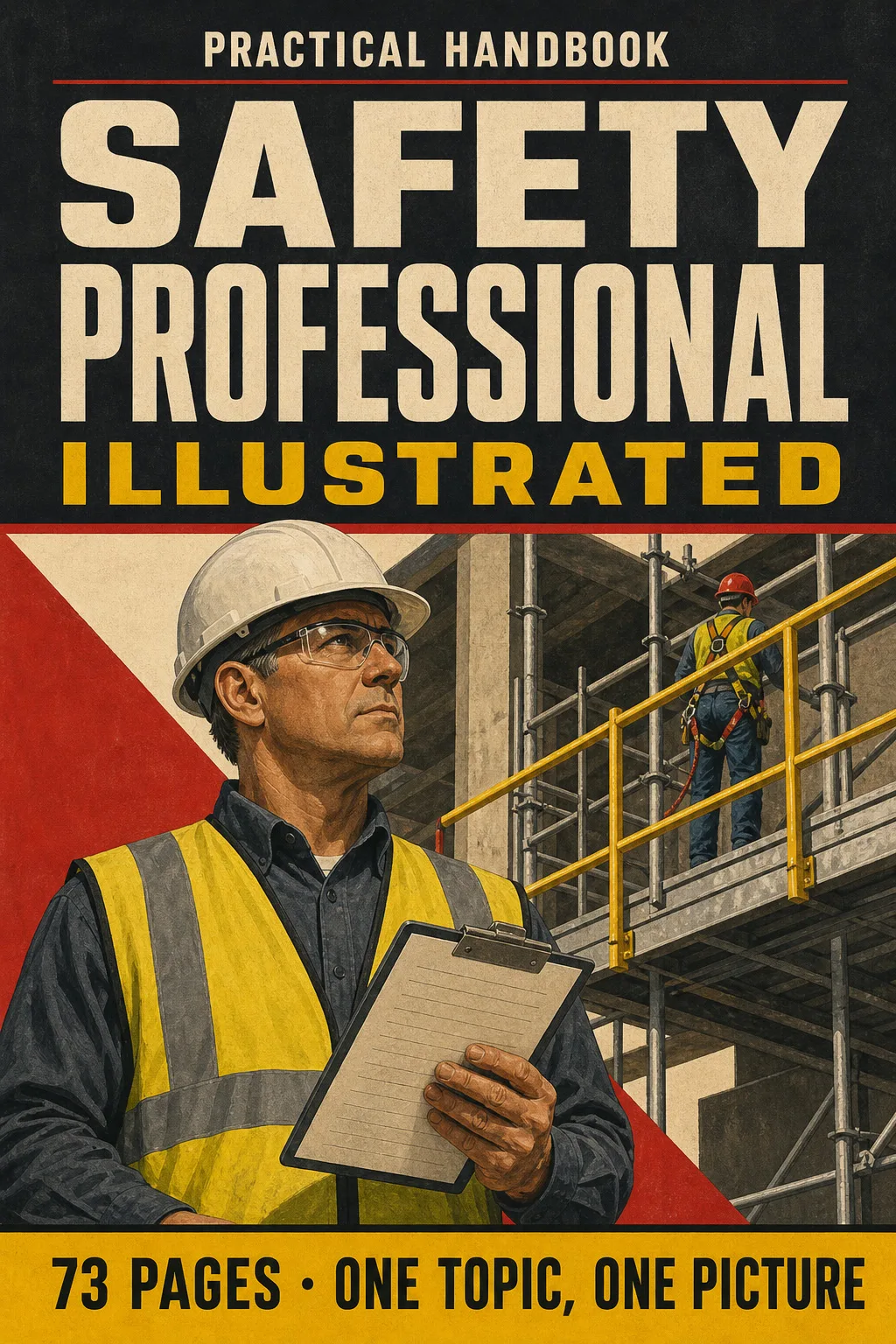
The ASP Exam and the OSHA Standards, Explained in Drawings One Topic on Every Page

The hierarchy of controls, incident rates, TWA and noise, OSHA recordkeeping, lockout/tagout, confined spaces, fall protection, industrial hygiene and PDCA. Each topic gets its own page: the drawing first, then what you need to remember. 73 illustrated pages.

GET THE ILLUSTRATED ASP GUIDE

🔒 Secure checkout · PDF by email · 30-day guarantee

Every topic, its own pageEach standard and each formula drawn, with the explanation right beside it
73 illustrated pages9 parts, from the ASP blueprint to the final exam-day checklist
Up-to-date sourcesBCSP's ASP blueprint, OSHA 29 CFR on eCFR and NIOSH
PDF by emailFormat

Look Inside the Book

Every page has one big drawing and a box with the numbers, steps and standards you need to know:

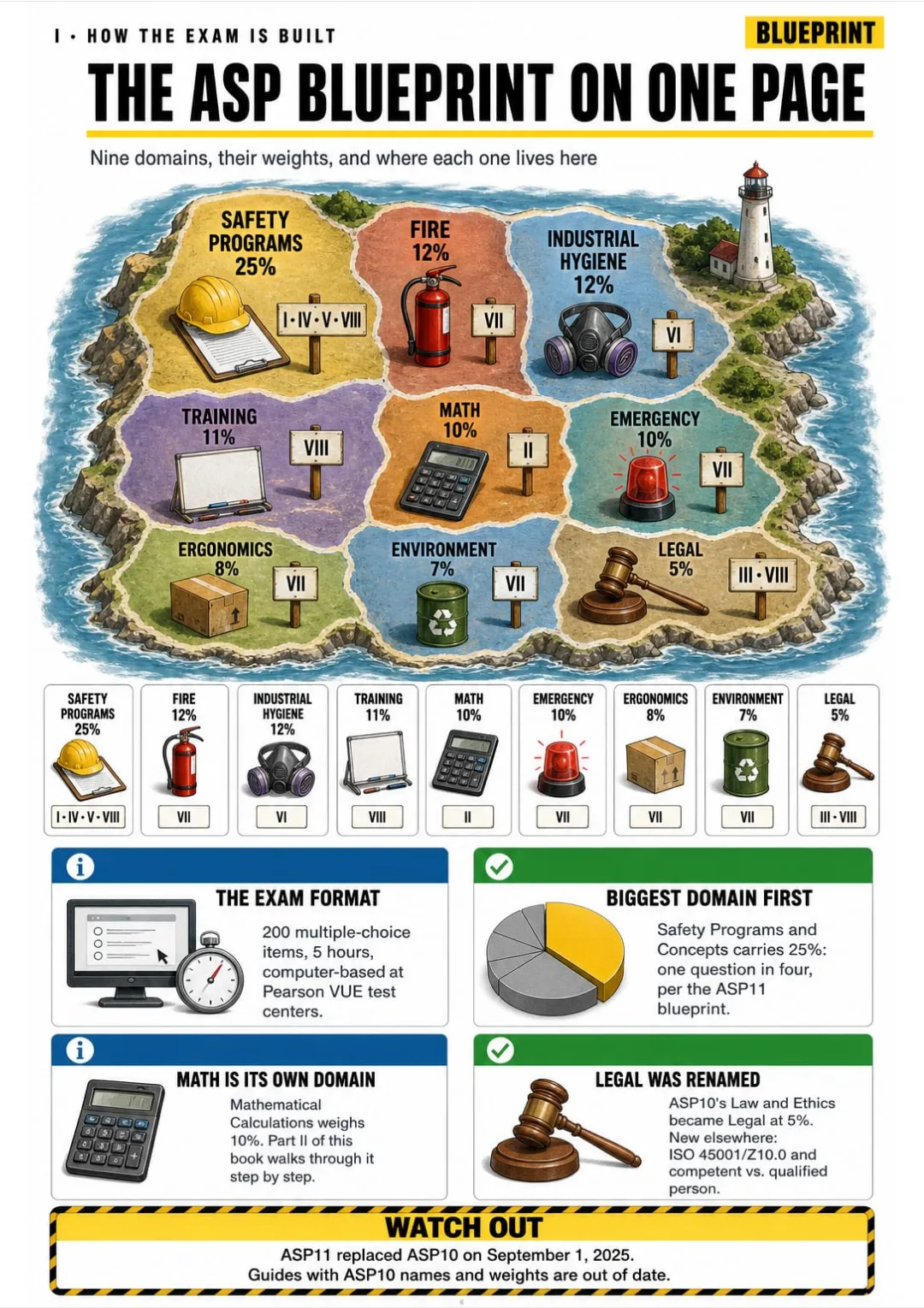
ASP11: 9 domains, from Safety Programs 25% to Legal 5%, 200 items in 5 hours
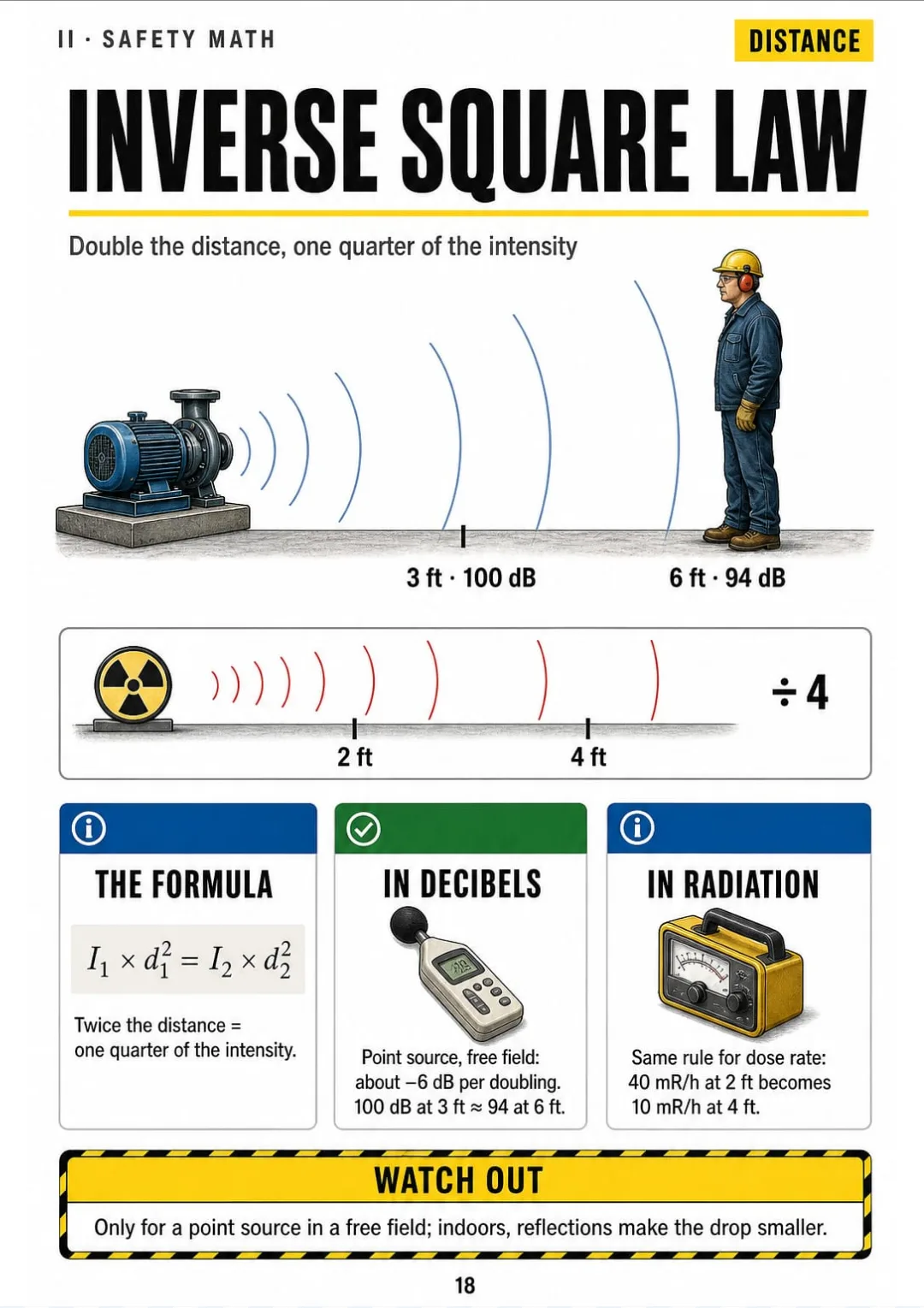
I₁d₁² = I₂d₂² · 100 dB at 3 ft ≈ 94 dB at 6 ft
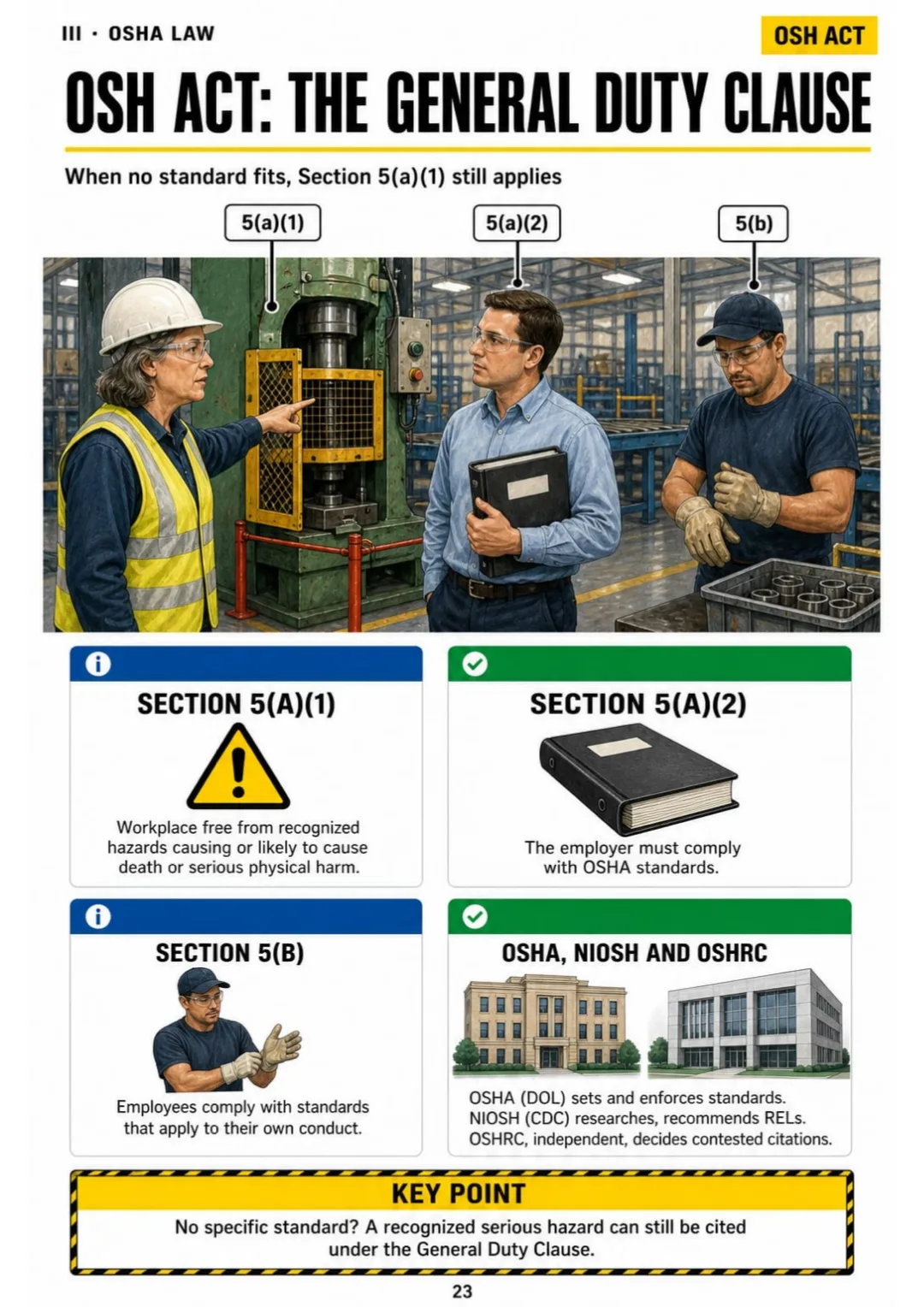
OSH Act Section 5: 5(a)(1) General Duty, 5(a)(2) standards, 5(b) employees.
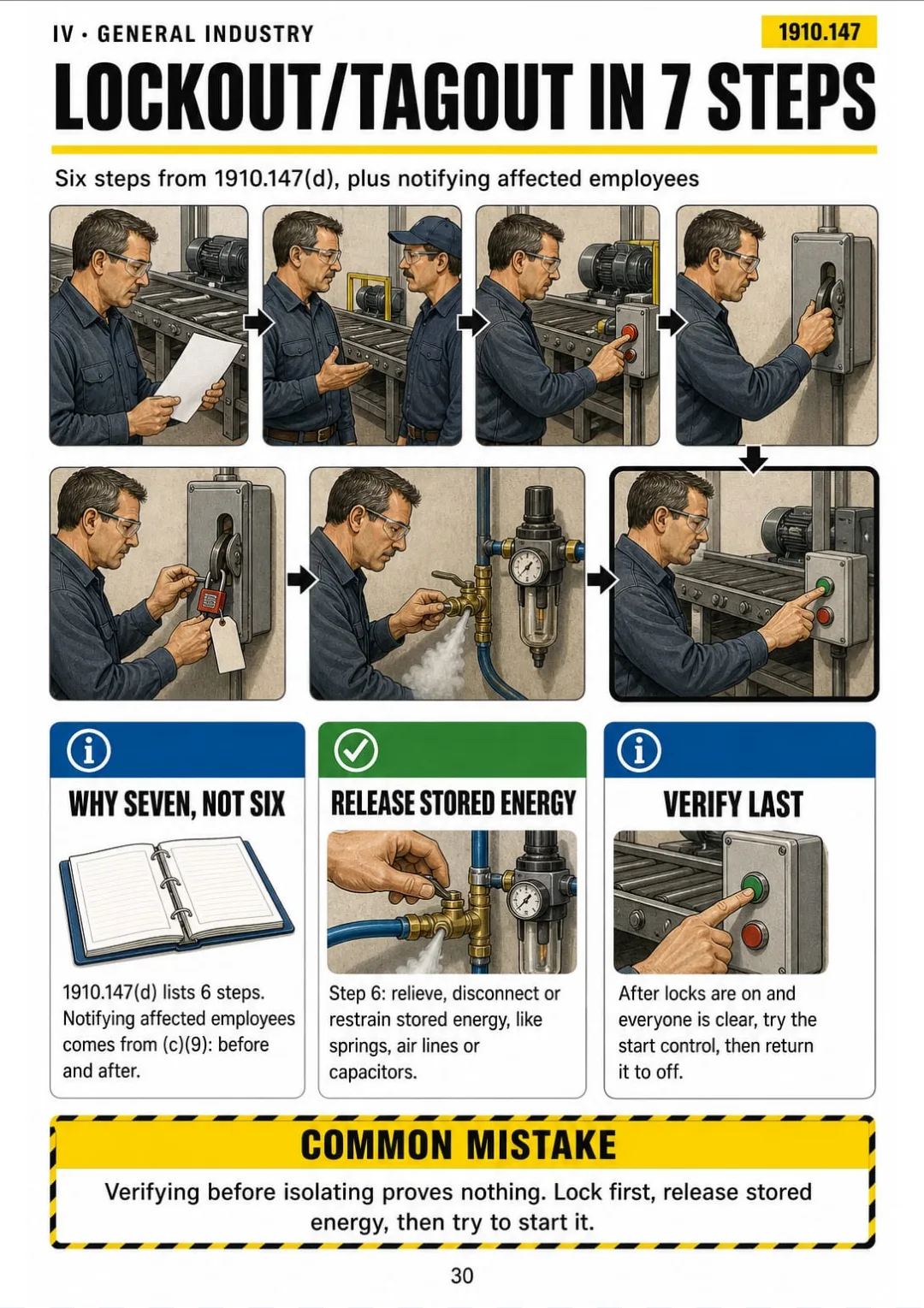
The 1910.147(d) energy control sequence plus the (c)(9) notification, numbered 1 to 7.
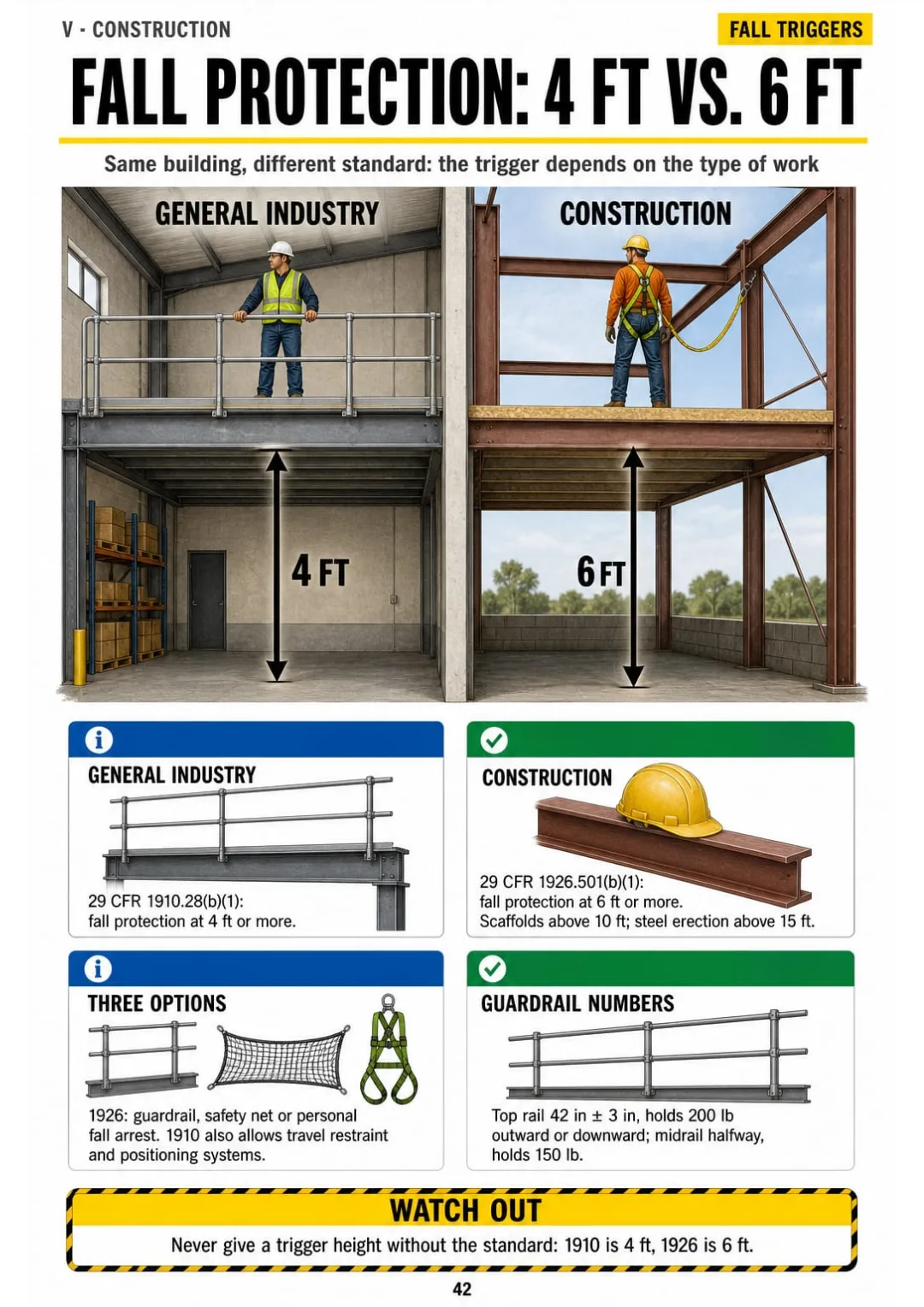
1910.28: 4 ft · 1926.501: 6 ft · scaffolds 10 ft · top rail 42 in ± 3 in, 200 lb
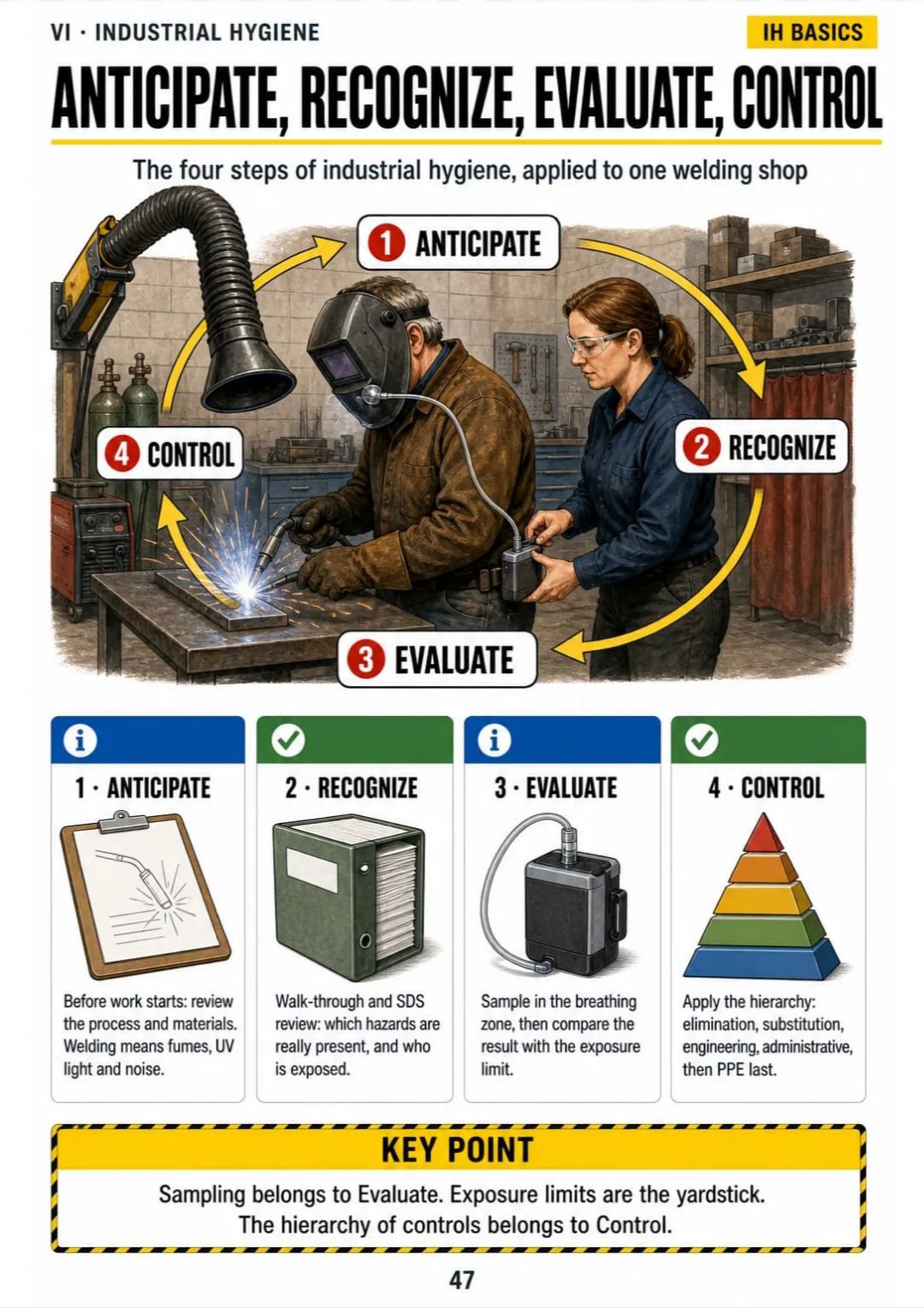
Anticipate → Recognize → Evaluate (sampling vs. limit) → Control (hierarchy), drawn in one welding shop.
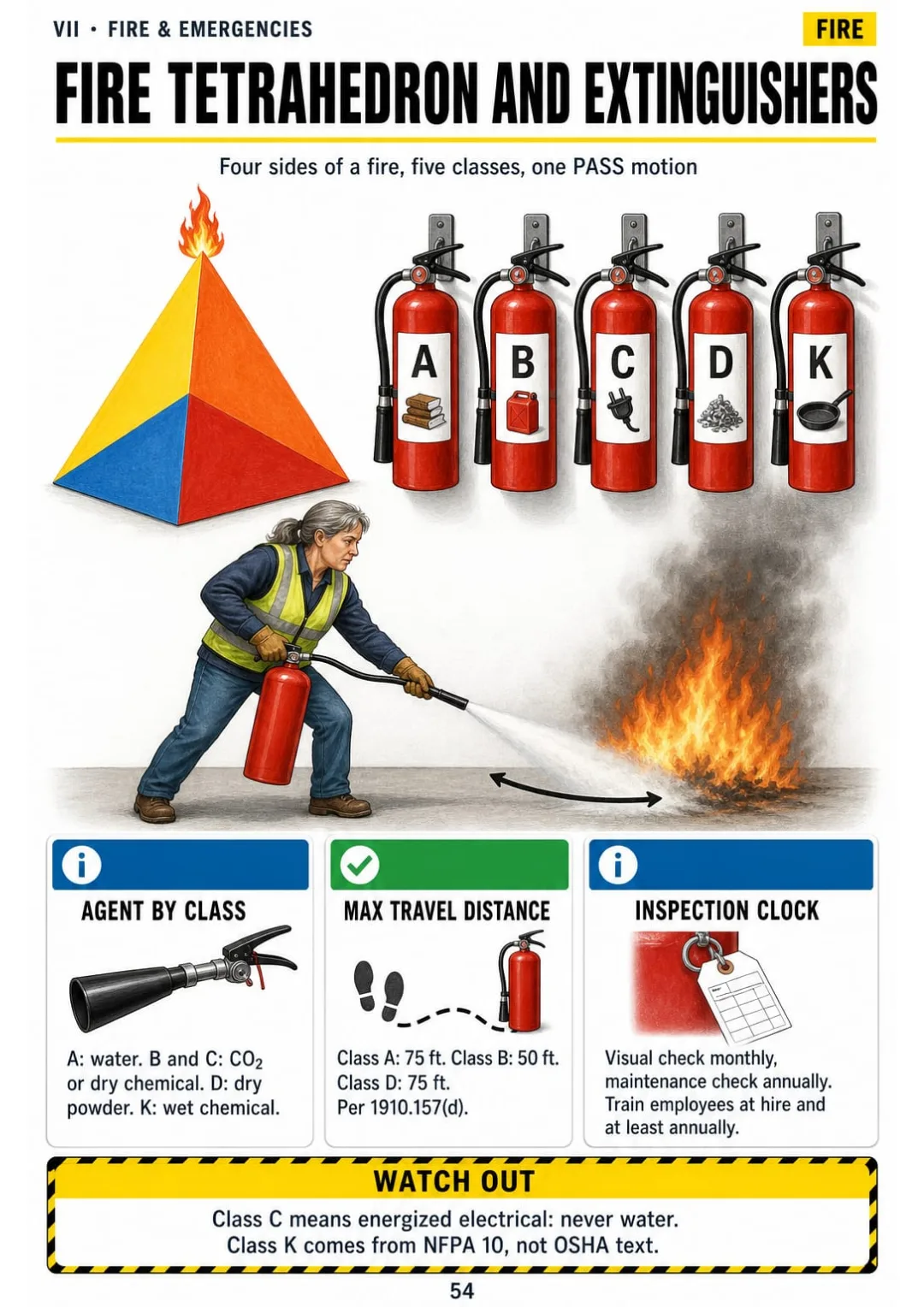
Classes A, B, C, D, K with agent; travel distance A 75 ft, B 50 ft (1910.157)
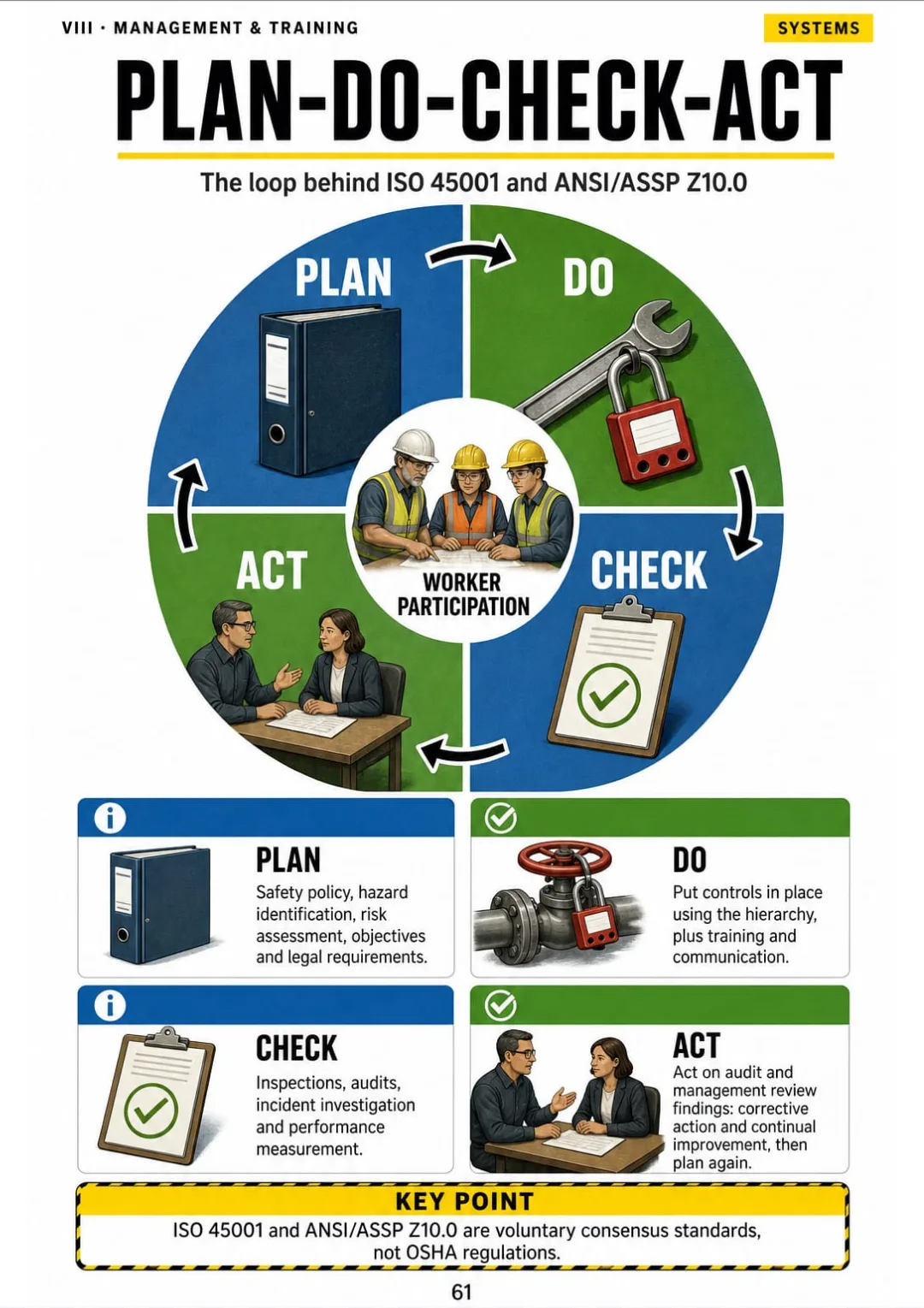
PDCA: policy → controls → audits → management review, with workers in every quarter

Swipe to see more →

These are real pages from the book. The table of contents is the full one: 9 parts and 68 topics.

The Problem Isn't You. It's How It Was Explained to You.

You're walking the plant and you spot a hazard that no specific OSHA standard covers. Your manager asks if OSHA can still cite it. You know the answer is somewhere in the OSH Act.

The manual gives you Section 5 in long paragraphs: employer duties, standards, employee duties, all run together. You read it after the shift, and by morning 5(a)(1) and 5(a)(2) are the same blur.

OSH Act Section 5: 5(a)(1) General Duty, 5(a)(2) standards, 5(b) employees.

In the book, Section 5 is one drawing: three boxes, 5(a)(1) General Duty, 5(a)(2) standards, 5(b) employees, each one showing who it applies to and what it looks like on the floor.

Same with the 1904 recordability path, lockout/tagout, permit-required confined spaces, the fall protection triggers and the TRIR math: each one has its own page.

So when the question comes, on the job or on the exam, you picture the page and answer without going back to the manual.

COMPARE FOR YOURSELF

The Same Topic, Two Ways to Study It

THIS
  • The manual: line after line
  • Safety formulas explained only in words
  • You walk into the exam still unsure
The total recordable incident rate is calculated by multiplying the number of recordable injuries and illnesses entered on the OSHA 300 Log during the reference period by 200,000, a constant representing the annual hours of 100 full-time equivalent employees working 40 hours per week for 50 weeks per year, and then dividing the resulting product by the total number of hours actually worked by all employees during the same period, as determined from payroll or other time records, excluding vacation, sick leave and holidays.
FOR THIS
  • The incident rate in one drawing
  • The 200,000 and the 3 steps in a box
  • You see it and you get it
I₁d₁² = I₂d₂² · 100 dB at 3 ft ≈ 94 dB at 6 ft
CONTENTS

Take a Look at the 9 Parts and 68 Topics

How the exam is built, safety math, OSHA law and recordkeeping, general industry, construction, industrial hygiene, fire and ergonomics, management systems and an exam-day review: 73 pages, all illustrated.

IHow the ASP Exam Is Built · pp. 6-9
  1. The ASP Blueprint on One Page
  2. How to Read an OSHA Citation
  3. The Hierarchy of Controls
  4. Risk = Likelihood × Severity
IISafety Math, Step by Step · pp. 10-22
  1. Incident Rate (TRIR) in 3 Steps
  2. DART and Severity Rate
  3. Unit Conversions Without Panic
  4. ppm to mg/m³ and Back
  5. 8-Hour TWA, Always in the Same Order
  6. Exposure to Mixtures
  7. Noise Dose and Permissible Time
  8. Adding Decibels
  9. Inverse Square Law
  10. Statistics You Need
  11. Probability and System Reliability
  12. Forces, Energy and Sling Angles
  13. Electricity Math: Ohm's Law
IIIOSHA Law and Recordkeeping · pp. 23-29
  1. The OSH Act and the General Duty Clause
  2. Citation Types and the Contest Clock
  3. Is It Recordable? The 1904 Decision Path
  4. First Aid vs. Medical Treatment
  5. Counting Days Away and Restricted
  6. OSHA 300, 300A and 301
  7. What to Report to OSHA, and When
IVGeneral Industry Standards · pp. 30-41
  1. Lockout/Tagout in 7 Steps
  2. The Energy Sources You Lock Out
  3. Permit-Required Confined Space: The 4 Triggers
  4. Atmospheric Testing: The Order Matters
  5. Entrant, Attendant, Entry Supervisor
  6. HazCom: The 6 Label Elements
  7. The 16-Section SDS
  8. Respiratory Protection: APF and MUC
  9. PPE Hazard Assessment
  10. Machine Guarding
  11. Forklifts (Powered Industrial Trucks)
  12. Electrical Safe Work Practices
VConstruction Standards · pp. 42-46
  1. Fall Protection Triggers: 4 ft vs. 6 ft
  2. Personal Fall Arrest: The Numbers
  3. Ladders and Scaffolds
  4. Excavations and Soil Types
  5. Cranes and Rigging Basics
VIIndustrial Hygiene and Health · pp. 47-53
  1. Anticipate, Recognize, Evaluate, Control
  2. Routes of Entry and Dose-Response
  3. PEL, REL, TLV and Action Level
  4. Ventilation: Q = V × A
  5. Heat Stress and WBGT
  6. Radiation: Time, Distance, Shielding
  7. Bloodborne Pathogens
VIIFire, Emergencies, Ergonomics, Environment · pp. 54-60
  1. Fire Tetrahedron and Extinguisher Classes
  2. Flammable Liquid Categories
  3. Exit Routes and the Emergency Action Plan
  4. NIOSH Lifting Equation
  5. Ergonomic Risk Factors
  6. Environmental Laws Map
  7. Emergency Response and Incident Command
VIIIManagement Systems, Training and Ethics · pp. 61-68
  1. Plan-Do-Check-Act
  2. Leading vs. Lagging Indicators
  3. Job Hazard Analysis in 4 Steps
  4. Root Cause: 5 Whys and Fishbone
  5. FMEA and Fault Tree Analysis
  6. Management of Change
  7. Training Adults: ADDIE
  8. Ethics for Safety Professionals
IXExam-Day Review · pp. 69-73
  1. Every Formula on One Page
  2. Most Frequent Math Mistakes
  3. Numbers That Look Alike
  4. Your Study Plan by Domain
  5. Final Checklist Before the Exam

One Page, One Topic, All Clear

Think of it this way:

Exam day. A lockout scenario: one machine, two energy sources, a maintenance crew waiting. You need the steps in the right order, right now.

You picture the lockout/tagout page you studied: the 1910.147 energy control sequence drawn as 7 numbered steps, from notifying the affected workers to verifying zero energy.

1910.28: 4 ft · 1926.501: 6 ft · scaffolds 10 ft · top rail 42 in ± 3 in, 200 lb

Same with the TRIR math, the 4 ft vs. 6 ft triggers, permit-required confined spaces, the 8-hour TWA and the extinguisher classes: each one on its own page.

Safety Professional Illustrated is 9 parts and 68 topics, all drawn, and it closes with every formula on one page, the most frequent math mistakes and a final checklist before the exam.

What you see drawn, you don't have to memorize.

What's Inside Safety Professional Illustrated:

Ipp. 6-9

How the ASP Exam Is Built

The ASP blueprint by domain, how to read an OSHA citation, the hierarchy of controls and risk as likelihood × severity.

IIpp. 10-22

Safety Math, Step by Step

Safety math you can follow line by line: TRIR, DART and severity rate, ppm to mg/m³, 8-hour TWA, noise dose, adding decibels, sling angles and Ohm's law, each one solved with real numbers.

IIIpp. 23-29

OSHA Law and Recordkeeping

OSHA law and recordkeeping, so you can tell recordable from first aid without opening 1904: the OSH Act and the General Duty Clause, citation types, the recordability path, counting days, the 300, 300A and 301 forms, and what to report.

IVpp. 30-41

General Industry Standards

Lockout/tagout, energy sources, permit spaces and atmospheric testing, entry roles, HazCom labels, the 16-section SDS, respirators, PPE, machine guarding, forklifts and electrical work practices.

Vpp. 42-46

Construction Standards

Fall protection triggers, personal fall arrest numbers, ladders and scaffolds, excavations and soil types, cranes and rigging.

VIpp. 47-53

Industrial Hygiene and Health

The industrial hygiene cycle, routes of entry, PEL, REL, TLV and action level, ventilation, heat stress and WBGT, radiation and bloodborne pathogens.

VIIpp. 54-60

Fire, Emergencies, Ergonomics, Environment

Fire tetrahedron and extinguisher classes, flammable liquids, exit routes and the EAP, the NIOSH lifting equation, ergonomic risk factors, environmental laws and incident command.

VIIIpp. 61-68

Management Systems, Training and Ethics

PDCA, leading vs. lagging indicators, JHA, 5 Whys and fishbone, FMEA and fault trees, management of change, ADDIE and ethics.

IXpp. 69-73

Exam-Day Review

Every formula on one page, the most frequent math mistakes, numbers that look alike, a study plan by domain and a final checklist.

At the end of the book: Every formula on one page, the most frequent math mistakes and a study plan by domain.
Plus: 2 Free Books

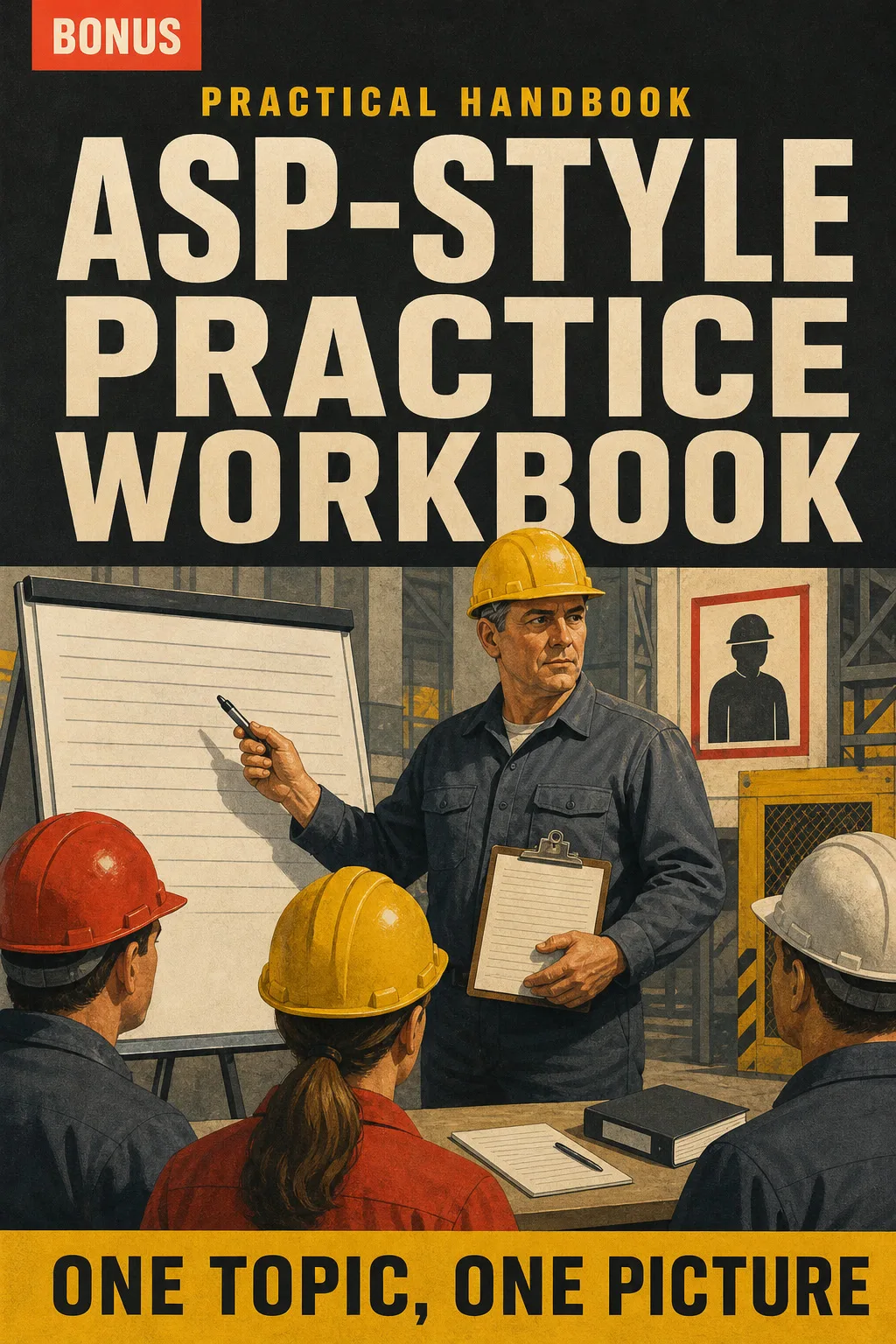
ASP-Style Practice Workbook

BONUS 1: «ASP-Style Practice Workbook»

Value on its own: US$ 17.90

Exam-style questions on every topic of the book, each with the answer explained, so you find your weak spots before exam day.

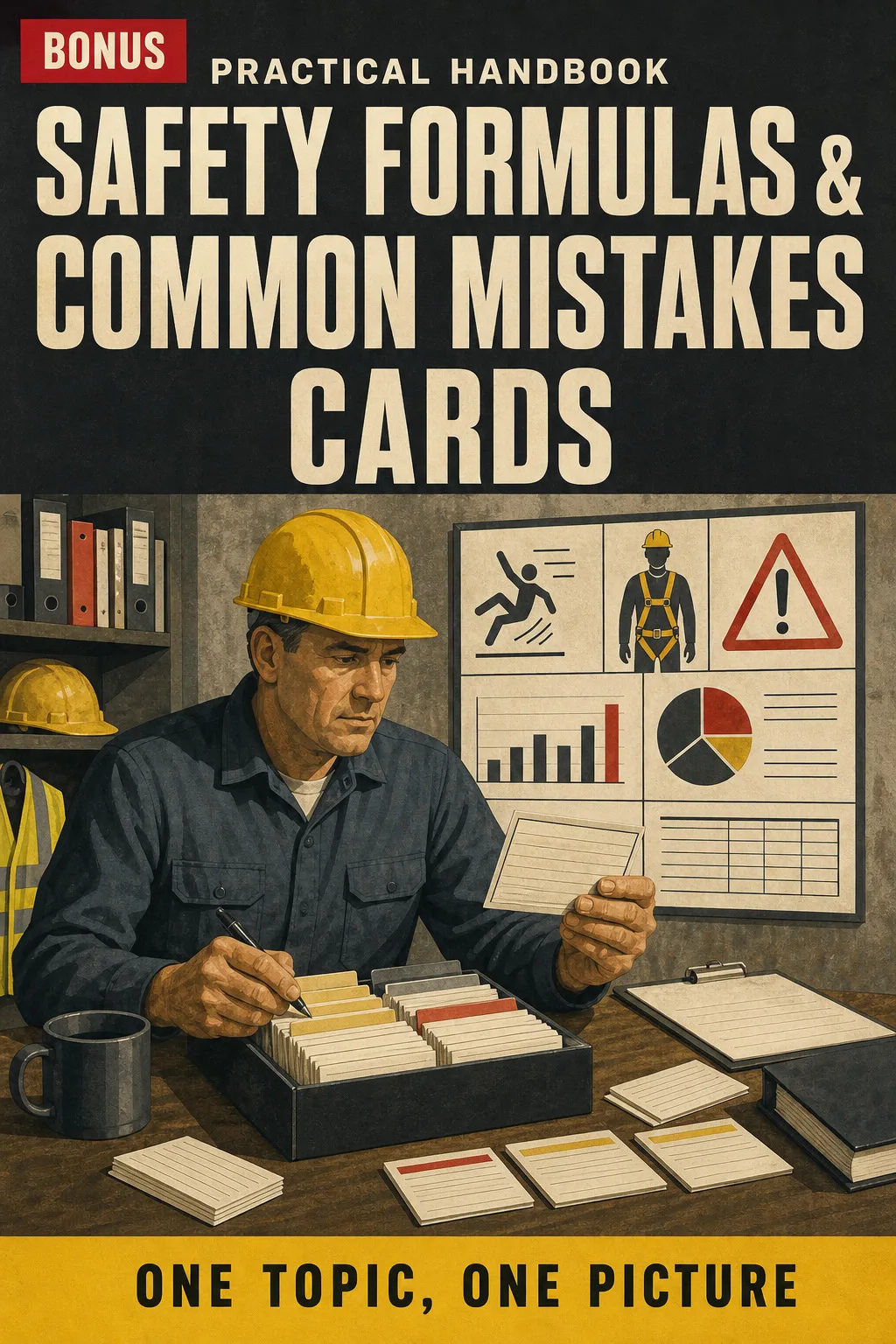
Safety Formulas & Common Mistakes Cards

BONUS 2: «Safety Formulas & Common Mistakes Cards»

Value on its own: US$ 14.90

Every formula and its constant on printable one-page cards, next to the most frequent mistakes, to review in ten minutes before a study session.

Safety Professional Illustrated with 2 Free Books

  • Safety Professional Illustrated: 73 illustrated pagesUS$ 63
  • BONUS 1: ASP-Style Practice WorkbookUS$ 17.90
  • BONUS 2: Safety Formulas & Common Mistakes CardsUS$ 14.90
  • High-resolution PDF to printIncluded
Total value US$ 95.80
YOUR PRICE:
US$ 27
You save US$ 68.80
YES, I WANT SAFETY PROFESSIONAL ILLUSTRATED FOR US$ 27

📄 This is a digital PDF book sent to your email: nothing is printed or shipped.

Secure purchaseEncrypted payment30-day guarantee

PDF by email: We email you Safety Professional Illustrated as a PDF, together with the two free books. It's a single payment: no installments, no extra charges.

Who This Book Is For

You're studying for the ASP

You're studying for the ASP

You get the whole blueprint in order, one drawn page per topic, so each study night after the shift has a clear start and finish.

Your exam date is set

Your exam date is set

The formulas, the look-alike standard numbers and the most frequent math mistakes are in the review part, ready for the last weeks.

You already work in safety

You already work in safety

Lockout steps, fall protection triggers and recordkeeping rules on printed pages you can keep in the truck or at the site office.

Everything You Get Today

US$ 95.80US$ 27
YES, I WANT SAFETY PROFESSIONAL ILLUSTRATED FOR US$ 27

📄 This is a digital PDF book sent to your email: nothing is printed or shipped.

30DAYS
GUARANTEE

30-Day Guarantee

Try Safety Professional Illustrated for 30 days, bonus books included.

We refund everything if the file won't open, if the book isn't what you see here, if you were charged twice or if the email doesn't arrive. Just email us.

You pay once. No subscriptions.

Frequently Asked Questions

Is it for me if I already work in safety and have my OSHA 30?

Yes. It doesn't explain what a hard hat is. It organizes the ASP topics you already half-know, one drawn page each, and works the math step by step.

Where does the content come from?

From the ASP Examination Blueprint published on bcsp.org (9 domains, 200 questions, 5 hours), the official text of OSHA 29 CFR 1904, 1910 and 1926 on eCFR, and NIOSH publications.

Is this official material?

No. It's an independent study guide, not affiliated with or endorsed by BCSP, OSHA or any exam body.

Does it replace an ASP prep course or formal training?

No, and it doesn't give a certificate or CEUs. If you already have the manual and a question app, this is the piece in between: one drawn page per topic, so when a practice answer doesn't make sense, you see why. It doesn't replace a course, your employer's training or the official text of the standards.

Are the practice questions the ones on the exam?

No. The workbook questions are written for this book in the style of the exam. They are not official ASP questions.

When and how does it arrive?

The book and the 2 bonus books arrive as a PDF by email, at the address you enter at checkout.

Do I have to pay every month?

No. It's a one-time payment. No subscription.

Can I have it on paper?

Yes. The PDF is made to print, at home or at a print shop, so you can keep it at your desk or take it to the site.

How does the refund work?

You have 30 days. We refund everything if the file won't open, if the book isn't what you see on this page, if you were charged twice or if the email doesn't arrive: just email us.

Before You Close This Page

No more rereading with nothing to show for it.

Incident rates and lockout steps: you see them drawn and you're set.

You walk into the ASP knowing where everything is.

Drawings make studying faster.

The book is right below.

One-time payment: US$ 27 · Guarantee: 30 days · PDF by email

YES, I WANT SAFETY PROFESSIONAL ILLUSTRATED FOR US$ 27

📄 This is a digital PDF book sent to your email: nothing is printed or shipped.